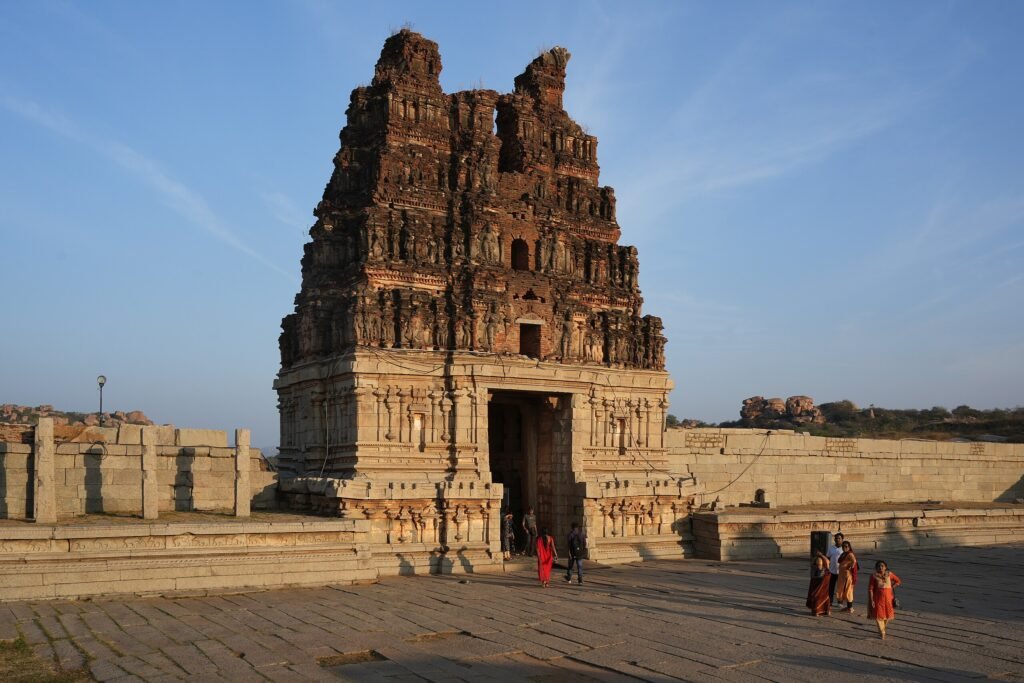
Vijaya Vittala Temple
Hampi: The Stone Symphony of the Vijayanagara Empire
Group of Monuments at Hampi
Lord Vittala (Vishnu)
15th Century AD
The Vijaya Vittala Temple is the most famous historical landmark in Hampi. Dedicated to Lord Vittala, an incarnation of Lord Vishnu, the temple complex is a testament to the unparalleled creativity and architectural expertise of the Vijayanagara sculptors. It remains a magnificent ruins site that draws historians, pilgrims, and travelers from across the globe.
| Architectural Element | Historical Detail |
|---|---|
| Patronage | King Devaraya II & King Krishnadevaraya |
| Famous Landmark | The Stone Chariot (featured on ₹50 note) |
| Musical Wonder | 56 Sa-Re-Ga-Ma Pillars in the Maha Mantapa |
| Entry Mode | Battery-operated carts available from the gate |
1
The Legend of Vittala’s Return
A fascinating legend suggests that Lord Vishnu (Vittala) found this temple so grand and luxurious that he deemed it too magnificent for him to reside in. He supposedly returned to his humble abode in Pandharpur, and the temple, though consecrated, never held a regular presiding deity for worship in the modern era, leaving it as a pristine architectural monument.
2
The Musical Pillars (Sa-Re-Ga-Ma)
The Ranga Mantapa houses 56 musical pillars, also known as Sa-Re-Ga-Ma pillars. When gently tapped with the thumb or a sandalwood stick, they produce distinct musical notes. This was used by ancient musicians to provide percussion during temple dances.
-
•
Acoustic Engineering: British engineers once cut two pillars to see if they were hollow or filled with something, only to find they were solid granite—proving the “music” came from the varied density and proportions of the stone. -
•
Micro-Carvings: Look closely at the base of the pillars to find intricate carvings of dancers, horses, and various mythical creatures (Yalis).
The King’s Balance (Tulapurushadhana)
Nearby is the King’s Balance, where the Vijayanagara kings were weighed against gold, silver, and precious stones on special occasions, which were then distributed to the temple priests and the poor. It stands as a symbol of the immense wealth of the empire.
Find Vittala Temple on Google Maps
Visitor Information
- ⏰ Timings: 8:30 AM to 5:30 PM.
- 🎟️ Entry Fee: Combined ticket for Vittala Temple, Lotus Mahal, and Elephant Stables (approx ₹40 for Indians, ₹600 for foreigners).
- 👟 Walking: Vehicles are stopped 1km away. You can walk the sandy path or take the electric buggy.
How to Reach
Nearest Station: Hospet Junction (HPT) – 13 km away.
Nearest Airport: Vidyanagar Airport (JVD) or Hubballi (HBX).
Pro Tip: Visit during the Hampi Utsav (Jan/Feb) to see the temple illuminated.
❓ Frequently Asked Questions (FAQ)
Q: Can we still touch and tap the musical pillars?
A: To prevent further erosion and damage to these 500-year-old structures, the ASI has currently cordoned off the musical pillars. You can view them from a close distance.
Q: Is the stone chariot actually a temple?
A: Yes, it is technically a shrine dedicated to Garuda, the vahana (vehicle) of Lord Vishnu, and it faces the main temple sanctum.
Q: How long does it take to see the whole Vittala complex?
A: Budget at least 1.5 to 2 hours to explore the main chariot, the musical hall, and the surrounding market ruins.