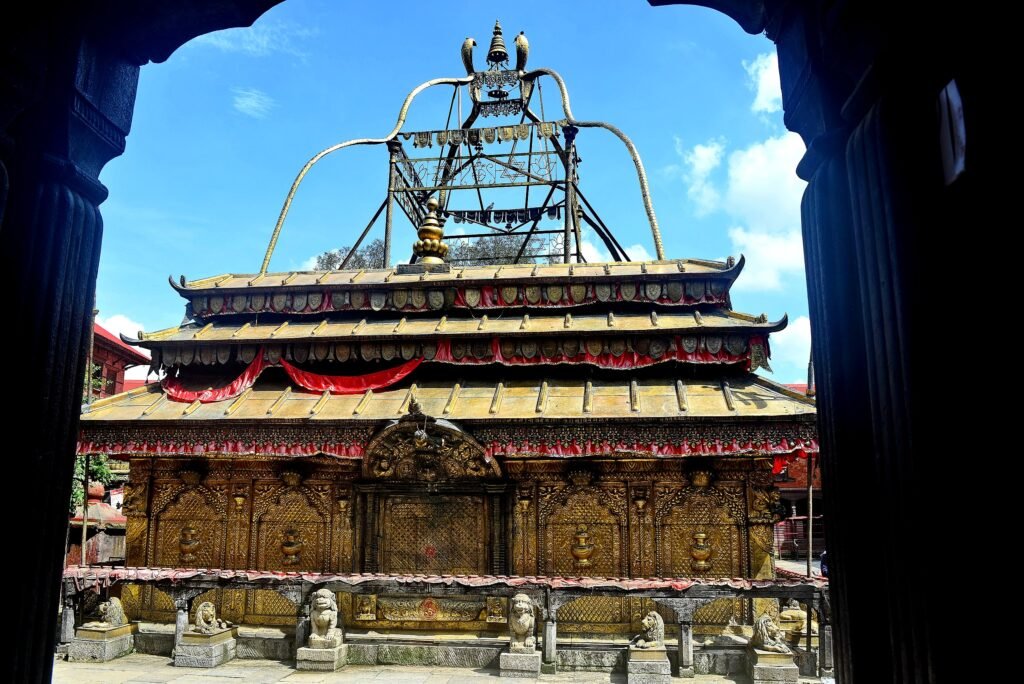
🕉️ Guhyeshwari Temple
The Hidden Power: Nepal’s Supreme Shakti Peetha
One of 51 Shakti Peethas
Both Knees of Sati
Kathmandu, Nepal
The **Guhyeshwari Temple** (also spelled Guhyeshwari or Guheshwari) is the most revered Shakti Peetha in Nepal and a site of immense importance for both Hindus and Buddhists. Located near the banks of the sacred Bagmati River and just 1 km from the famous Pashupatinath Temple, it is dedicated to Goddess Guhyeshwari—the secret or “hidden” form of Parvati. The temple is considered the feminine counterpart to Lord Pashupatinath, together representing the union of Shiva and Shakti.
📜 The Secret Legend of Sati
The Divine Falling
According to the *Shiva Purana* and *Swasthani Brata Katha*, Guhyeshwari marks the spot where the knees (some local versions suggest the hips or part of the torso) of Sati fell while Lord Shiva carried her charred body. The word “Guhya” translates to “Secret” or “Hidden,” and “Eshwari” means “Goddess,” symbolizing the deep, esoteric knowledge of the universe held by the Mother.
No Idol Worship
In a fascinating architectural choice typical of ancient Shakti sites, there is no statue of the Goddess in the inner sanctum. Instead, she is worshipped in a Kalash (sacred water jar) filled with silver and gold, placed inside a small, water-filled pit. This emphasizes the formless and primordial nature of the Goddess.
🏛️ Architectural Features: A Newari Masterpiece
The temple was significantly renovated and shaped into its current form by King Pratap Malla in the 17th century, reflecting the intricate Newari Pagoda style of the Kathmandu Valley.
1. Pagoda Structure: The temple is designed in a traditional multi-roofed style, but unlike other temples, it has a flat-topped roof supported by four pillars representing the four directions.
2. The Ashtadal (Eight Petals): Inside the sanctum, the “Guhya” (the pit/pond) is surrounded by a silver octagonal structure symbolizing the eight petals of a lotus, where the Matrikas reside.
3. Tantric Imagery: The temple walls and rafters are adorned with intricate wood carvings and paintings representing various Tantric deities and symbols, reflecting its status as a core site for Vajrayana Buddhism and Hindu Tantra.
✨ Spiritual Practices and Significance
Guhyeshwari is the site where the “hidden” power of the universe is worshipped. It is a mandatory visit for pilgrims who come to see Lord Pashupatinath; the pilgrimage is considered incomplete without paying respects at this Shakti site first.
Tantric Union
Both Hindu and Buddhist Tantric practitioners congregate here for meditation. In Vajrayana Buddhism, the Goddess is identified with Vajravarahi. During festivals, the water from the Bagmati River is brought to the temple for ritualistic purification of the sanctum.
📍 Location on Google Maps
🚗 Travel & Logistics
| Mode of Transport | Details |
|---|---|
| From Pashupatinath | A scenic 10-15 minute walk through the Pashupati forest area. |
| From City Center | Easily accessible via taxi from Thamel or Ratnapark (approx. 20 mins). |
| By Air | Tribhuvan International Airport (KTM) is just 2.5 km away. |
⚠️ Entry Restriction
Traditionally, only Hindus are allowed inside the main courtyard of the temple. Non-Hindus can view the temple exterior from the Bagmati river bank.
📅 Major Festivals
- Dashain: The 10-day celebration sees the temple at its most festive.
- Navratri: Thousands of women visit to seek marital bliss.
❓ Frequently Asked Questions (FAQ)
Q: Why is Guhyeshwari linked to Pashupatinath?
A: They represent the cosmic union of energy (Shakti) and consciousness (Shiva). One cannot be complete without the other.
Q: Is there an idol inside?
A: No, the deity is worshipped in a silver water-filled pit covered by a silver Kalash.
Q: What should I wear?
A: Traditional and modest clothing is required. Avoid leather belts or bags when entering the temple precincts.